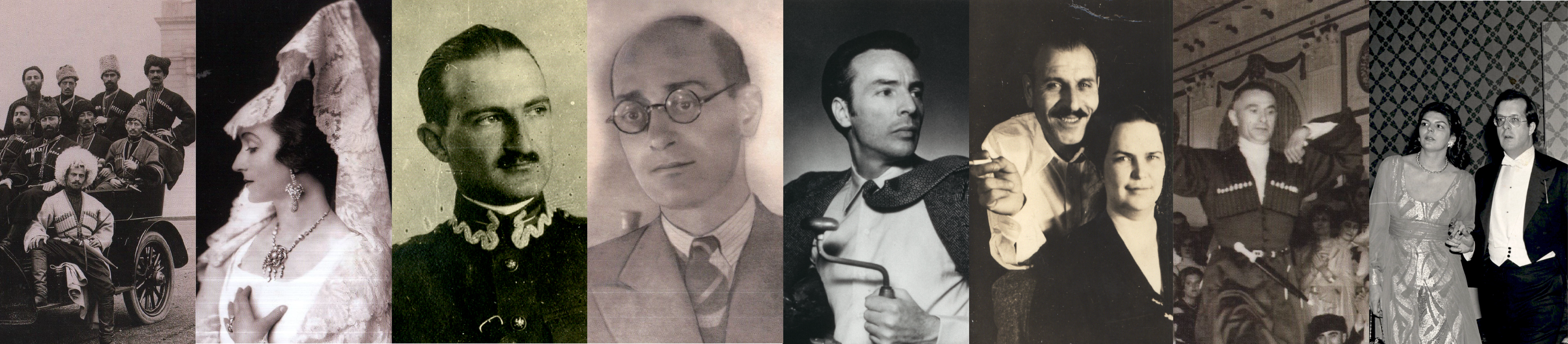
Georgian Trick Riders
Through they were often referred to as "Cossacks" or "Russians," a cohort of Georgian trick riders dazzled audiences across the American West.

Gurian Roots: The Origins of Trickriding in Georgia
The story of Georgian-American trick riders begins perhaps most aptly in Guria: a historically agrarian region of Western Georgia where horse riding traditions have been honed over the course of centuries. Indeed, horses and agrarian tradition were so central to life in Guria that disputes over grazing rights were one of the root causes underlying the region's brief seccession from 1902 to 1906. But the late 1800s were also fraught with changes for many Gurians. Despite its rural roots, the advent of the Transcaucasus Railway in 1872 and a subsequent labor pull to Batumi and Poti left the herding and riding traditions of Guria in a state of uncertainty. How would Georgian riding fare with the advent of industrialization and urbanization?
Around this same time, some Georgian trick riders began marketing their skills to shows and circuses in Europe and the Americas. Georgian riders even performed for influential figures like Theodore Roosevelt and Queen Victoria. No venue, however, lent itself so well to trick riding as the rodeo of the American West. In 1892, Thomas Oliver—a recruiter for Buffalo Bill—traveled to Guria to recruit riders for Buffalo Bill's infamous rodeo show. A pipeline quickly emerged for trick riders from Western Georgia to the wild West of the Americas.
Wild West Boiling Pot: Ethnic Diversity of the Early American Rodeo
The stereotypical American cowboy—a rider the likes of John Wayne, Buffalo Bill, or Butch Cassidy—is a white American man taking on the unknowns of the Wild West. A defining aspect of the 19th and 20th century American rodeo, however, was the highly multicultural element of life beyond the Mississippi. Removed from the traditions of the more established Northeast or the American South, many minority groups found space in the West to practice and expand cultural traditions that defied Anglo-American traditions elsewhere in the US. By some estimates, anywhere between a quarter and a third of the cowboys during the height of Western roundups were Black, Mexican, or Native American. The term "cowboy" itself stems from linguistic differentiation between white "cow hands" and Black cattle workers were referred to by the more demeaning "boy," often "cow boy." Indeed, Black riders were some of the earliest pioneers of rodeo life, with famous Black cowboys like Bill Picket and Jesse Stahl bringing bulldogging and bronc riding to the fore in the late 19th century.

Riders of Spanish or Mexican origin had a similarly significant role in the origins of the American rodeo: Charreria and the broader traditions of the haciendas of old Mexico were hugely influential in the riding culture of Western states like Texas, Arizona, New Mexico, and Colorado, where rodeo riding came into vogue. Mexican vaqueros contributed not only distinct riding style and tradition, but also vocabulary. The terms "bronco," "corral," and "rodeo" are all Spanish. Other terms evolved slightly, but still bear remnants of their Spanish origins; "chaps" stems from "chaparejos," "ranch" from "rancho," "lariat" from "la reata," "lasso" from "lazo," and "mustang" from "mestengo." Even the comically Western term "buckaroo" stems from the Spanish term "vaquero."
All this is to say that Georgians were one of many cultural groups in the West working in tandem to breathe life into the early American rodeo. With this multiculturalism, however, came frequent instances of exoticization and stereotyping for the sake of a primarily American audience. One memoir notes that "In America, the circus was also mobile. One such well-known big circus in America visited the city of Denver in 1912. Buffalo Bill's Circus, which represented the Wild West, and in which representatives of several dozen states took part in the species dressed in the uniforms of their countries. America, in addition to its well-known horse-playing cowboys (cowherds), was represented by a company of Indians in the representation of their inter-tribal wars, and to this day so armed and armed with indigenous women, children, and everything that they possessed during the wars, which they carried over and are now used for entertainment by the circus spectators ... so Georgians dressed in Circassian Chokha Akhalukh will perform the roles of England, Germany, France, Italy, Japan and others, including Russian Cossacks, about thirty men, who also play their roles well on horses. They are called Russian Cossacks.”

Thus, with the multiculturalism and spectacle of the rodeo also came gross oversimplification of the identities and cultures of many early rodeo riders. Just as indigenous or Mexican riders were often branded as exotic "Indians" without differentiation between the many indigenous groups of the Americas, so too were the backgrounds of Georgian riders pared down for the sake of rodeo spectacle. Georgian riders often dressed in the garbs of other countries for expos, but even when performing in their own clothing and riding style, were often introduced to audiences as "Russians" or "Cossacks." This erasure has only been rectified in contemporary histories which have revived evidence of the specific stories, traditions, and legacies of Georgian riders who helped shape the American rodeo into what it is today.
Georgian Riders as a Staple of the Early American Rodeo
With the early advent of Georgian riders in the 1880s, the trade of Georgian riding became highly marketable in the tumultuous industry of the American rodeo. One of the most famous rodeo entrepreneurs and riders of all time—Buffalo Bill—was known to recruit Georgians specifically, sending a representative directly to Georgia in at least one instance, and marketing the skills of his Georgian riders on promotional materials as his show traveled the American West.
Just as Georgians’ cultural identities were sometimes “fudged” for the sake of spectacle and showmanship, so too were the socioeconomic and personal backgrounds of these riders often somewhat murky. Riders were often portrayed as Georgian or Cossack “royalty.” Though evidence suggests that the majority of these riders were actually peasants, riders often played into supposedly royal identities; see, for instance, the brief biography of Prince Luka Chkhartishvili in the later section on famous riders.
There is also evidence to suggest that the flashy, colorful character of the American rodeo was influenced by Georgian fashions. As one memoirist wrote, “...Intrigued by the Cossacks' stunts on their galloping horses, western cowboys soon introduced variations to American rodeo. Colorful costumes seem to be a necessary part of trick riding, and it is quite possible that the outlandish western garb which has invaded rodeo arenas can be blamed directly on Cossacks and trick riders.”
Rodeo Stars: Famous Georgian Trick Riders

While the often tumultuous life of performers in the Western rodeo circuit makes it difficult to estimate the number of Georgian riders who were active in the 19th and early 20th century, a number of Georgian riders gained national or even international acclaim for their innovations in performance riding. The acrobatics and explosive style of Georgian riders dazzled audiences across the US; here are just a few of the riders whose legacies put Georgian trick riders on the map.
Ivane Makharadze
Born in the Georgian village of Bakhvi, Ivane Makharadze took to horse riding at a young age. In 1880, after running away to Batumi following a dispute with his father, Makharadze joined the crew of a ship bound for New York. Once he reached the US, Makharadze worked several odd jobs before finding employment as a cleaner for a New York circus. Makharadze eventually rose to the station of horsekeeper for the circus, and after saving up enough money to purchase his own horse, joined the circus as a trick rider. Some documentary evidence suggests that Makharadze's impression on the circus scene around 1885 may have prompted Thomas Oliver's trek to Guria to recruit other Georgian riders for Buffalo Bill's rodeo.
Prince Luka Chkhartishvili

A native of Batumi, Luka Chkhartishvili came to be known as “Prince” Luka Chkhartishvili during his escapades in the American West. Chkhartishvili supposedly gained his title before immigrating to the US, and claimed to have earned his title from his compatriots, as opposed to having inherited it through royal lineage. Regardless of where his title came from, Chkhartishvili heavily emphasized his foreign royal character in performances throughout the American West. Chkhartishvili most notably popularized standing-based tricks (media as far east as the New York Daily Tribune reported on one of his accidents wherein Chkhartishvili’s horse stumbled and died as a result of one standing-trick accident) and side-hanging tricks. (Wherein Chkhartishvili would hang off the side of the horse, often upside down.)
Zakareishvili sisters
Hailing from Gurian village of Surebi, Maro and Barbale Zakareishvili gained acclaim even in their youth for their riding prowess. After travelling to the US to perform in American shows, the sisters attracted American audiences en masse, not only with their distinctive riding style, but also with the rare prospect of female trick riding. Maro dazzled audiences with her specialty trick of riding three horses at once, often insisting on showing audiences the soles of her shoes to prove that she wasn't glued down while performing the standing trick. One of Barbale's most famous trick was to hold the American flag while standing on the shoulders of two other mounted riders.
Alexis(Gogokhia) Georgian

Following a failed application to Tbilisi's theological institute, Alexis Georgian (then Alexis Gogokhia) moved to New York in 1894. After picking up English through a series of odd jobs, Gogokhia contacted Luka Chkhartishvili and was hired by Buffalo Bill's Wild West show. Gogokhia rode with the Bills through 1899, but left in 1900 to start his own group. As part of his independent show, Gogokhia rode under names including "Captain Georgian," "Colonel Georgian," and "Prince Georgian." By 1905, Gogokhia had purportedly attracted most of the Georgian riders in the US to his company. Gogokhia was later offered the post of Georgian ambassador to the US by the the democratic republic of 1918-1921, but turned the post down. Gogokhia ultimately lived out the rest of his life in the US, dying in Minneapolis in 1949.
Rodeo Stars to Movie Stars: Interplay between the American Western and Georgian Riding Tradition
Another somewhat inscrutable aspect of the connection between Georgia and the American West is the film genre of the American Western. During the Soviet era, American cowboy movies were largely prohibited, with Soviet censors worrying that the genre glorified American notions of individualism and lawless. The notion of a Western and a genre dedicated to riding culture, however, continued to intrigue Soviet citizens, but especially Georgians. An edited version of "The Magnificent Seven"--one of the few American Westerns ever screened in the Soviet Union--drew audiences of over 67 million Soviet viewers. In other instances, Soviet or European filmmakers attempted to adapt the style of the Western for Soviet censorship measures. "The Extraordinary Adventures of Mr. West in the Land of the Bolsheviks" was one such instance. "Trial of the Falcon" was another Soviet-oriented Western, much of which was filmed in Georgia as a result of Georgia's rich landscape and heavy riding tradition.
Legacy of Georgian Trickriding in the Modern American Rodeo
Given that still photography was still commonplace during the late 1800s, (as opposed to action shots) photo documentation of the fast-paced tricks of Georgian riders during the period is limited. The photos that do exist, however, bear a remarkable resemblance to many of the tricks that are considered staples of the American rodeo today. Hover over the images below to see some of the traces of Georgian trick riding in modern rodeo riding!


How Did They Get to America?
Through some sleuthing on Ancestry.com, we have identified a collection of boats and routes that the Trick Riders took while arriving to the United States.
